
Padel rules explained: the serve, the walls and scoring
Padel is quick to learn, but it has its own rules that set it apart from tennis, especially the serve and playing off the walls. This guide sums up what you need to know for your first match, and to avoid arguments at the change of ends.
The serve
- You serve underarm: the ball is struck at waist height or below.
- Before you hit it, the ball must bounce on the ground behind the service line.
- You serve diagonally and the ball must bounce inside the opposite service box.
- If, after bouncing in the box, the ball hits the glass, the serve is good. If it hits the metal mesh, it’s a fault.
- You get two attempts. If the ball touches the net and lands in the box, the serve is replayed.
- The return can’t be volleyed: you have to let the ball bounce.
Playing off the walls
The walls are what make padel special. The key rule is simple: the ball must first bounce on the ground of the opposing court. After that it can hit the glass and the mesh.
- You can let the ball bounce off your glass walls and hit it afterwards.
- You can hit the ball against your own wall to send it over: that’s the “contrapared”. We explain it in how to play the contrapared.
- If your shot hits your opponent’s glass or mesh directly without bouncing on their ground first, you lose the point.
- On courts that allow it, you can leave the court through the doors to return a ball.

The most common faults
- Touching the net with your body or racket while the ball is in play.
- The ball touching your body: you lose the point.
- Hitting the ball twice, or after it has bounced twice on your side.
- The ball bouncing on your side and going out over the fence without you returning it.
How points are scored
Just like tennis: 15, 30, 40 and game. A set is won with 6 games and a lead of at least two. At 6-6, a tie-break is played to 7 points with a two-point lead. Matches are usually best of three sets.
At 40-40 there are three ways to continue, and it’s worth agreeing on one before you start:
| System | What happens at 40-40 | Where it’s used |
|---|---|---|
| Advantages | You have to win two points in a row | Traditional friendly matches |
| Golden point | A single point decides the game; the receiving team chooses the side | Many amateur leagues |
| Star Point | Up to two advantages and, if still tied, a deciding point | The professional tour since 2026 |
We explain it in detail in Star Point: the new scoring system.
Basic equipment
To get started you only need padel shoes, balls and a forgiving racket. Take a look at our rackets for beginners or models like the Siux Astra Control 2026 and the Nox X-Zero 2026.
Rackets you might like
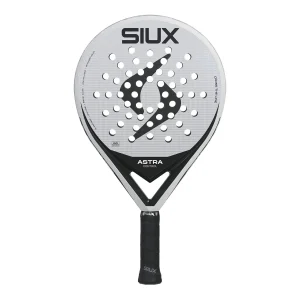

Not sure which one to choose? Take the “Find your racket” quiz or browse all rackets.